

Germany Autonomous Farm Equipment Market Growth Led by Deere, AGCO, CNH
Autonomous Farm Equipment
Germany Autonomous Farm Equipment Market advances with AI-driven precision agriculture
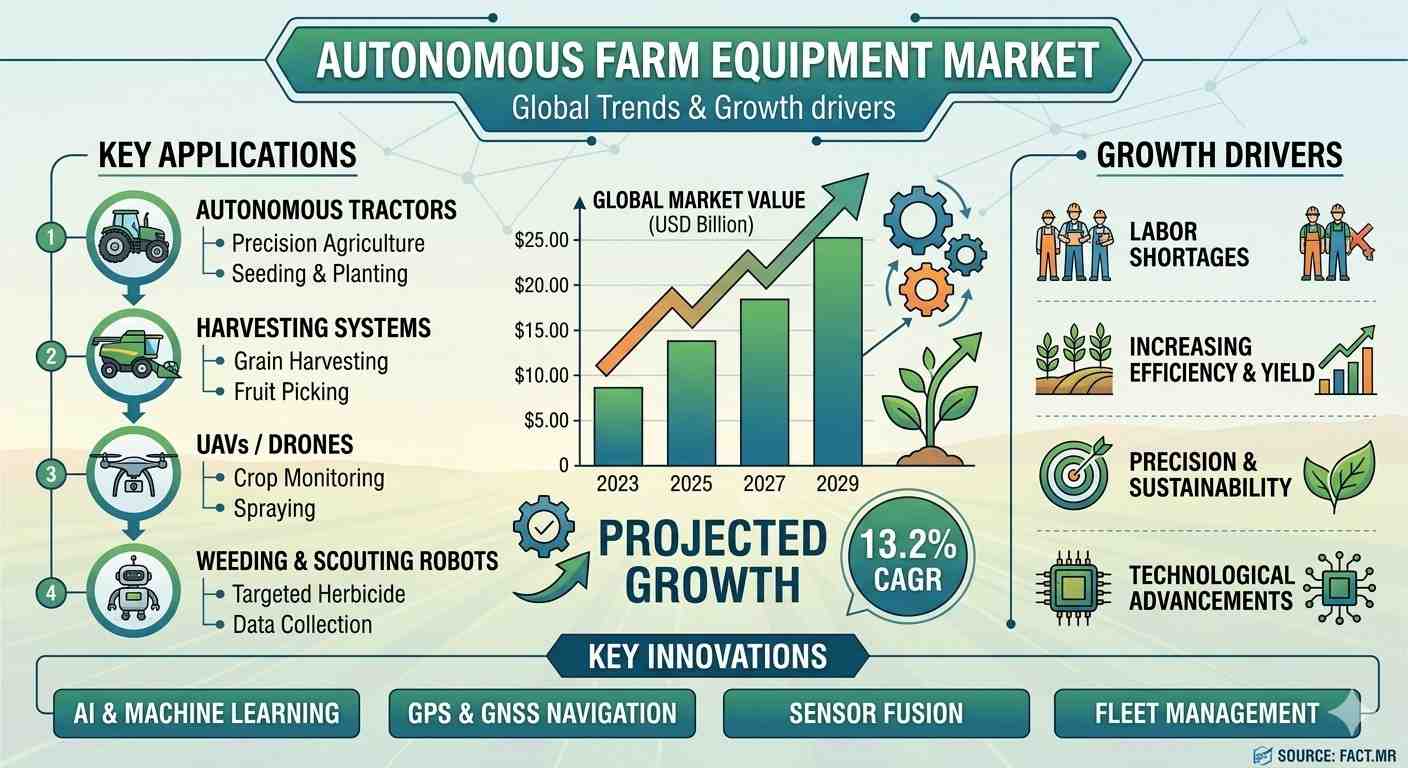
ROCKVILLE, MD, UNITED STATES, April 15, 2026 /EINPresswire.com/ -- According to Fact.MR’s latest analysis, the Germany autonomous farm equipment market is transitioning into a technology-led precision agriculture ecosystem, driven by structural labor shortages and the need for higher productivity.Market size reached USD 11.2 billion in 2025 (global benchmark)
Estimated at USD 12.5 billion in 2026
Forecast to reach USD 37.5 billion by 2036
Germany projected to grow at 6.8% CAGR (2026–2036)
Generating USD 25.0 billion in global incremental opportunity, with Germany contributing steady high-value demand
The market is shifting from conventional mechanization to AI-, IoT-, and robotics-enabled autonomous systems, enabling continuous operations and data-driven decision-making across farms.
Get detailed market forecasts, competitive benchmarking, and pricing trends:
https://www.factmr.com/connectus/sample?flag=S&rep_id=5674
Quick Stats
Market Size (2025): USD 11.2 billion
Market Size (2026): USD 12.5 billion
Forecast Value (2036): USD 37.5 billion
Germany CAGR (2026–2036): 6.8%
Incremental Opportunity (Global): USD 25.0 billion
Leading Segment: Autonomous tractors (38.4% share)
Leading Technology: Partially autonomous systems (66.1% by 2036)
Leading Region: North America (32% share), with Germany as key EU market
Key Players: Deere & Company, AGCO Corporation, CNH Industrial, Kubota Corporation, Trimble Inc.
Executive Insight for Decision Makers
Germany’s agricultural sector is undergoing a structural shift toward automation-led farming models.
Strategic Shift: Transition from labor-intensive operations to data-driven, autonomous farm management
What Stakeholders Must Do:
Invest in precision agriculture platforms and autonomous systems
Adopt hybrid (partial autonomy) models for flexibility
Leverage data ecosystems for yield optimization
Risk of Inaction: Farms relying on traditional equipment risk declining productivity, higher costs, and inability to scale operations
Market Dynamics
Key Growth Drivers
Structural agricultural labor shortages across Germany and Europe
Increasing demand for precision farming and yield optimization
Rising input costs (fuel, labor, fertilizers) pushing automation
Government-led sustainability initiatives under EU frameworks
Key Restraints
High upfront capital investment for autonomous equipment
Limited economic viability for small-scale farms
Regulatory constraints on fully autonomous operations
Emerging Trends
Rapid integration of AI, IoT, and GPS-based navigation systems
Growth of autonomy-as-a-service and retrofit solutions
Expansion of autonomous UAVs for spraying and monitoring
Increasing focus on electric and sustainable farm machinery
Segment Analysis
Leading Segment: Autonomous tractors hold 38.4% share (2026)
Core to plowing, planting, and field operations
Fastest-Growing Segment: UAVs and robotic harvesters
Driven by accessibility and lower entry cost
Breakdown
Equipment Types: Tractors, harvesters, UAVs, irrigation systems
Technology: Fully autonomous, partially autonomous
Applications:
Agricultural farms
Dairy and livestock management
Greenhouses and orchards
Strategic Importance:
Partially autonomous systems dominate due to flexibility and regulatory compliance, making them the preferred entry point for German farmers.
Supply Chain Analysis (Critical Insight)
Value Chain Structure
Component Suppliers
Sensors, GPS modules, LiDAR, AI chips, connectivity systems
Equipment Manufacturers (OEMs)
Deere & Company, AGCO Corporation, CNH Industrial
Technology Providers
Precision agriculture software and data analytics platforms
Distributors & Dealer Networks
Provide financing, leasing, and aftersales services
End Users
Large-scale farms, cooperatives, agri-corporations
Who Supplies Whom
Component suppliers → OEMs (hardware integration)
OEMs → Dealers/distributors (equipment delivery & financing)
Dealers → Farmers and agribusinesses
Key Insight:
Strong dealer networks and financing models are critical enablers of adoption, particularly in capital-intensive markets like Germany.
Pricing Trends
Premium Equipment Model: High upfront cost with long-term ROI
Key Influencing Factors:
Hardware (LiDAR, sensors, AI systems)
Software subscriptions and data platforms
Government subsidies and financing options
Margin Insights:
Higher margins in software and precision agriculture services
Hardware margins influenced by competition and scale
Regional Analysis (Germany Focus with Global Context)
Top Countries by CAGR
India – 16.2%
Brazil – 14.4%
China – 13.8%
Australia – 11.2%
United States – 9.6%
Germany – 6.8%
Germany Growth Drivers
Advanced precision agriculture ecosystem
Strong regulatory framework supporting safe automation
Demand from large farms and high-value crop segments
Developed vs Emerging Markets
Germany & EU: Regulation-driven, high-tech adoption
Emerging Markets: Subsidy-driven, volume expansion
Competitive Landscape
Market Structure: Moderately consolidated with strong OEM dominance
Key Players
Deere & Company
AGCO Corporation
CNH Industrial
Kubota Corporation
Trimble Inc.
Mahindra & Mahindra
Yanmar Holdings
Competitive Strategies
Integration of data platforms and farm management software
Expansion of autonomous and retrofit solutions
Strengthening dealer networks and financing models
Focus on precision agriculture ecosystems
Strategic Takeaways
For Manufacturers
Invest in AI-enabled equipment and software ecosystems
Expand modular and scalable product offerings
For Investors
High-growth potential in agri-tech and precision farming solutions
Focus on firms with recurring revenue models (software/services)
For Marketers & Distributors
Emphasize ROI, productivity gains, and sustainability benefits
Offer flexible financing and leasing models
Future Outlook
Germany’s autonomous farm equipment market will evolve into a data-centric agricultural ecosystem.
Increasing adoption of fully integrated smart farming platforms
Expansion of autonomous operations across crop cycles
Rising role of AI in predictive farming and decision-making
Long-term growth will be defined by technology convergence and sustainable agriculture practices.
Conclusion
The Germany autonomous farm equipment market is redefining agricultural productivity through automation, intelligence, and precision.
As labor shortages intensify and sustainability becomes a priority, autonomous systems are no longer optional—they are becoming foundational to modern farming economics. Companies that align with this transformation will unlock significant competitive advantages.
Why This Market Matters
Germany represents a critical hub for precision agriculture innovation in Europe, where technology adoption, regulatory frameworks, and sustainability goals converge. The shift toward autonomous farming is not just a trend—it is a long-term transformation shaping the future of global food production.
Full Report: Unlock 360° insights for strategic decision making and investment planning-
https://www.factmr.com/checkout/5674
To View Related Report:
Autonomous Forklift Market https://www.factmr.com/report/autonomous-forklift-market
Autonomous Tractors Market https://www.factmr.com/report/autonomous-tractors-market
Autonomous Last Mile Delivery Market https://www.factmr.com/report/autonomous-last-mile-delivery-market
Autonomous Underwater Vehicle Market https://www.factmr.com/report/autonomous-underwater-vehicle-market
S. N. Jha
Fact.MR
+ +1 628-251-1583
email us here
Legal Disclaimer:
EIN Presswire provides this news content "as is" without warranty of any kind. We do not accept any responsibility or liability for the accuracy, content, images, videos, licenses, completeness, legality, or reliability of the information contained in this article. If you have any complaints or copyright issues related to this article, kindly contact the author above.
